 AI SI Daily
It could have been stronger. Moonshot AI held it back on purpose
Moonshot AI's Kimi K3.1 Pro: 2.8 trillion total parameters, a 1M-token context, full weights before November 4. But first, a rarer detail: it could have been stronger.
Yesterday, Kimi’s official account posted a 24-second video of a retro computer. Sharp-eyed viewers spotted an Easter egg in the top-left corner: the model field in Kimi Code read “Model: Kimi K3.1”.
Today, Moonshot AI officially released Kimi K3.1 Pro. It is the first model in the K3.1 series and, in Moonshot AI’s words, “the strongest 3T-class open-weight model available today.” The most important numbers first:
- 2.8 trillion total parameters (MoE architecture, 104 billion active per inference), a 1-million-token context window, and multimodal support for text and images
- Already live on the Kimi web app and mobile apps, Kimi Work, Kimi Code and the Kimi API
- Full weights will be released before November 4
But before getting into how strong it is, there’s a rarer detail worth telling first: it could have been stronger.
To go open, it deliberately “hobbled itself”
The technical blog devotes an entire section to cybersecurity safeguards, and it deserves to come first.
Moonshot AI found that the more it scaled up post-training, the more noticeably the model’s ability to find vulnerabilities grew. The gains came from security content mixed into ordinary training data and from security tasks in the reinforcement learning environments. To be comfortable releasing the weights, the team deliberately removed cybersecurity-related data from both the post-training and the reinforcement learning stages.
The cost is real. On an internal exploit test, the version trained without removing that data solved 90.5% of the problems; the released K3.1 Pro solves 81.0%. The company states its principle plainly: open weights should not push the absolute frontier of cybersecurity capability, but the security capabilities available in open models will be raised step by step, so that more teams can audit the code they maintain.
Amid a sea of benchmark-first launches, it’s rare to see a lab deliberately dial a capability down and then publish the numbers. And if even the held-back version can do that, what it actually delivers is the real subject of this article.
Not a new model, but K3’s post-training “final form”
K3.1 Pro uses the same base model as Kimi K3, released in July this year. The difference is post-training: this round, Moonshot AI put far more compute into post-training, ran reinforcement learning across hundreds of domains at once, and focused on long-context reasoning and agentic code-sandbox environments.
How big is the effect? One number says it all. On the Artificial Analysis Intelligence Index, K3 scored 44 and K3.1 Pro scores 55, an 11-point jump from one round of post-training, putting it fourth in the world, behind only Claude Opus 5.5 (58), Claude Sonnet 5.5 (56) and Muse Wonder Full (56). Once the weights land on November 4, it will be the strongest open-weight model on that leaderboard, and the gap between open and closed models will shrink from 12 points to 3.
Developers also dug another small change out of SGLang code commits ahead of time: a new medium thinking-effort level (K3 had three: low / high / max), which lets everyday use burn a little less reasoning budget.
The main battleground is coding, specifically the “get-the-job-done” kind
The biggest gains this round are in agentic coding: letting the model open a terminal, use tools and finish a job over multiple steps on its own:
| Benchmark | K3.1 Pro | Claude Opus 5.5 | GPT-6 Astra | Previous-gen K3 |
|---|---|---|---|---|
| Terminal-Bench 4.0 (real terminal tasks) | 65.7% | 66.4% | 58.2% | 13% |
| SWE Marathon v1.1 (long-horizon software engineering) | 51.7% | 46.3% | 42.5% | — |
| GDPval-AA (general agentic tasks, Elo) | 1,846 | 1,866 | 1,573 | 1,534 |
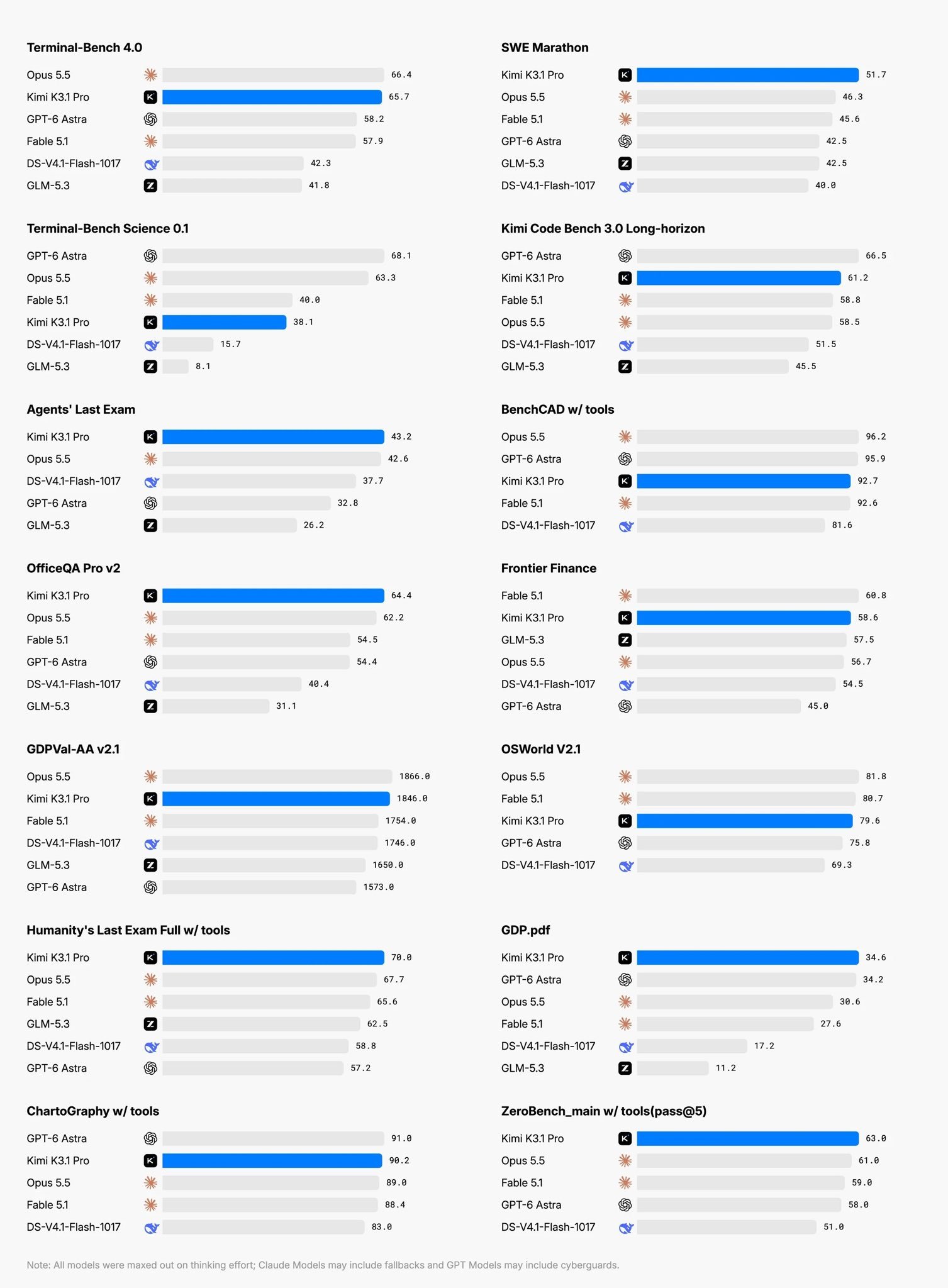
Figure: Moonshot AI’s official benchmark comparison, with every model at maximum thinking effort (the company notes that Claude models may include fallback and GPT models may include cyberguards).
The chart also shows weak spots. Going through the technical blog, X user Aurora (@MingTian685474) pointed out that on Terminal-Bench Science, K3.1 Pro scores just 38.1, 30 points behind first-place GPT-6 Astra at 68.1 (post).
What does going from 13% to 65.7% on Terminal-Bench mean? It means going from “basically unusable” to “just 0.7 percentage points behind today’s strongest closed model.” On SWE Marathon, it even overtakes Opus 5.5 and GPT-6 Astra. The company also showed off a case study: the model independently completed a walking-simulator project, an anatomical model with 296 skeletal components and 402 muscle components. After 167 development tasks and 420 rounds of self-checking, it got the virtual character to walk continuously for 11.2 seconds.
The series also gains a K3.1 Pro Highspeed variant with the same capabilities, 2–3x the speed and double the price. The standard API is priced at $2 input / $10 output (per million tokens), one-third cheaper than K3.
Beyond coding: 3D and finance are the other two showcases
3D modeling: On BenchCAD, which tests reconstructing 3D models from images and outputting CAD code, K3.1 Pro scores 92.7% with tools, close behind Opus 5.5 (96.2%). It needs no plugins: it writes its own scripts to drive Blender and CAD software, and it can build complete game projects in Unity, Unreal and Godot. kimi.ai also launched a “3D Make” feature alongside it, letting users preview and edit models online and download them directly for 3D printing.
Finance: On OfficeQA Pro v2, which tests data analysis on real financial documents, it took the top score of 64.4. On internal financial-modeling and financial-research tests, it improved on K3 by 7.2 and 11.6 points respectively. More important is reliability: on Kimi Hallu Bench Hard, a stress test the company deliberately designed to “lure the model into mistakes,” its statement-level hallucination rate fell from K3’s 23.4% to 8.3%, a drop of about 65%. In a field like finance, where one wrong number can cause real damage, that improvement matters more than any benchmark score.
Hands-on reports: how it really feels beyond the benchmarks
Beyond the official numbers, in the day or so around the launch plenty of developers on X have already put it to work on their own tasks. The results are far more divided than the benchmark charts: front-end and 3D demos drew wide praise, while real codebases and subscription quotas drew plenty of complaints.
Front end and 3D: the first strengths on display
Chetaslua (@chetaslua): Got test access before the official release and posted a side-by-side video of K3.1 Pro and Claude Fable 5.5 generating the same “pelican riding a bicycle” animated scene, captioned simply “we are eating well this week” (post). In another post, he said K3.1 Pro took 15 minutes to one-shot a demo website; that post drew more than 2,000 likes (post).

Figure: Frame from the comparison video Chetaslua posted, with Kimi K3.1 Pro on the left and Claude Fable 5.5 on the right.
Pranav Reddy (@AI_Screening): Had K3.1 Pro, Opus 5.5 and GPT-6 Astra each build a running horse in “a single HTML file + Three.js.” His verdict: Kimi “cooked Astra” and is now competing at the frontier (post). The video got more than 1,400 likes and was reshared with commentary in the Chinese-speaking community too: SuSu_酥酥 (@NFT_Chen) judged Kimi’s running gait the most natural, Opus well coordinated overall but somewhat stiff, and Astra broken in both proportions and animation (post).
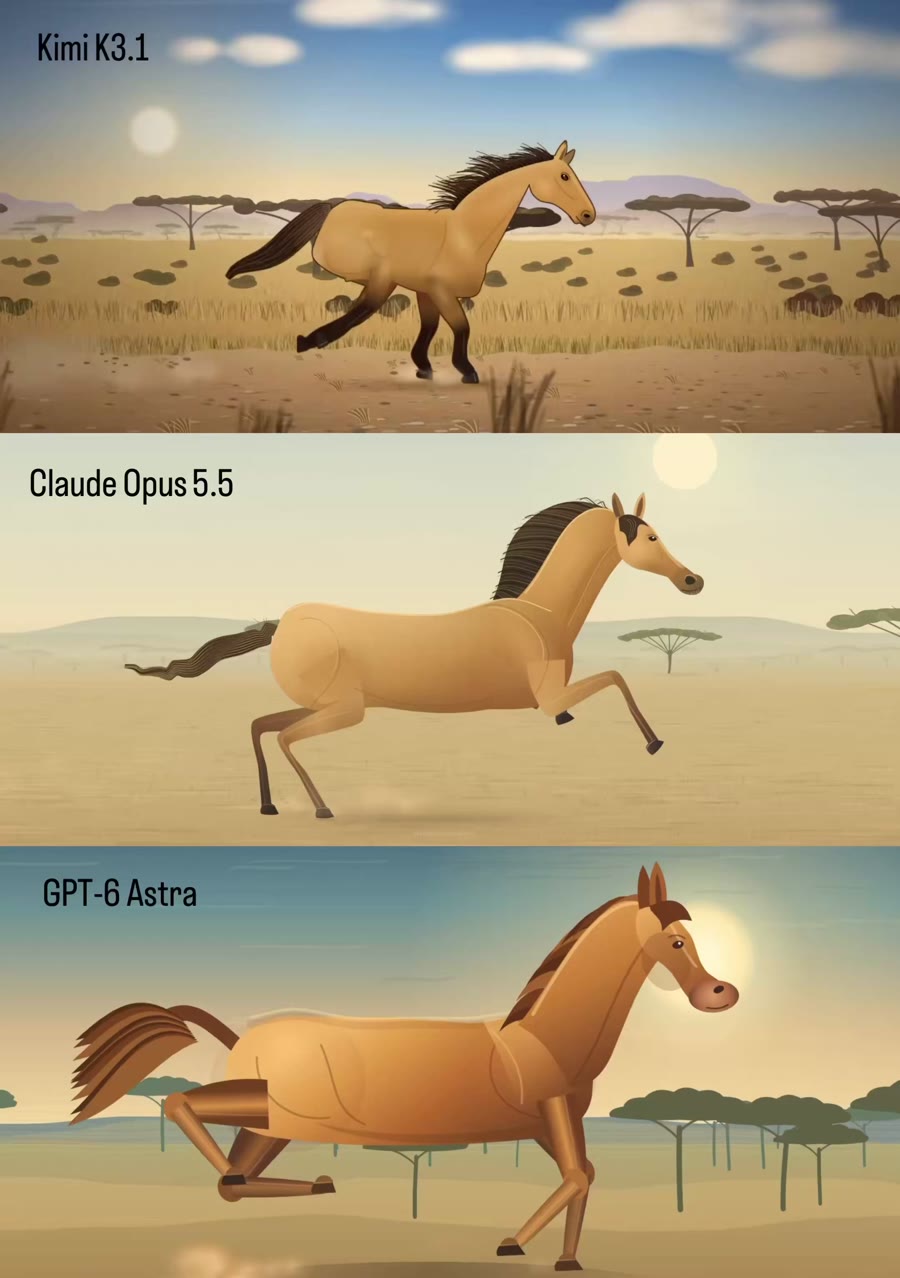
Figure: Frames from Pranav Reddy’s single-file Three.js running-horse test, top to bottom: Kimi K3.1, Claude Opus 5.5, GPT-6 Astra.
Dominique Silvestre (@domsilvestre): Reran the same prompts he had used to test K3 on October 6, one shot, no fixes. In the Eiffel Tower scene, K3 produced only a glowing tower over grey blocks, while K3.1 Pro built a lit-up city with fireworks. His verdict: “Opus is still ahead, but not by much.” On cost, the 3 scenes came to $1.51 with K3.1 Pro, versus $2.02 with K3 and $13.83 with Opus (post).
A third-party leaderboard offers indirect confirmation: Arena.ai (@arena) reported that K3.1 Pro ranks 8th in Code Arena: WebDev with 1692 points, tied with Claude Opus 5 (Max) and 9 places above K3. At $2/$10 pricing, its median cost per task is $1.23 (post).
Real codebases: Opus is still more dependable
Paweł Huryn (@PawelHuryn): Replanted 105 bugs across 2 code repositories and had the models find and fix them on their own. DeepSeek V4.1 Flash 1017 fixed 42.7, Opus 5.5 fixed 41.7 and K3.1 Pro fixed 36 (all at max). His conclusion was blunt: “Considering the cost, I see no reason to use this model.” (post) The leaderboard he posted shows K3.1 Pro clearly improving on K3 (default), which fixed 21, but at $13.76 per run it costs far more than DeepSeek V4.1 Flash 1017 at $1.84.
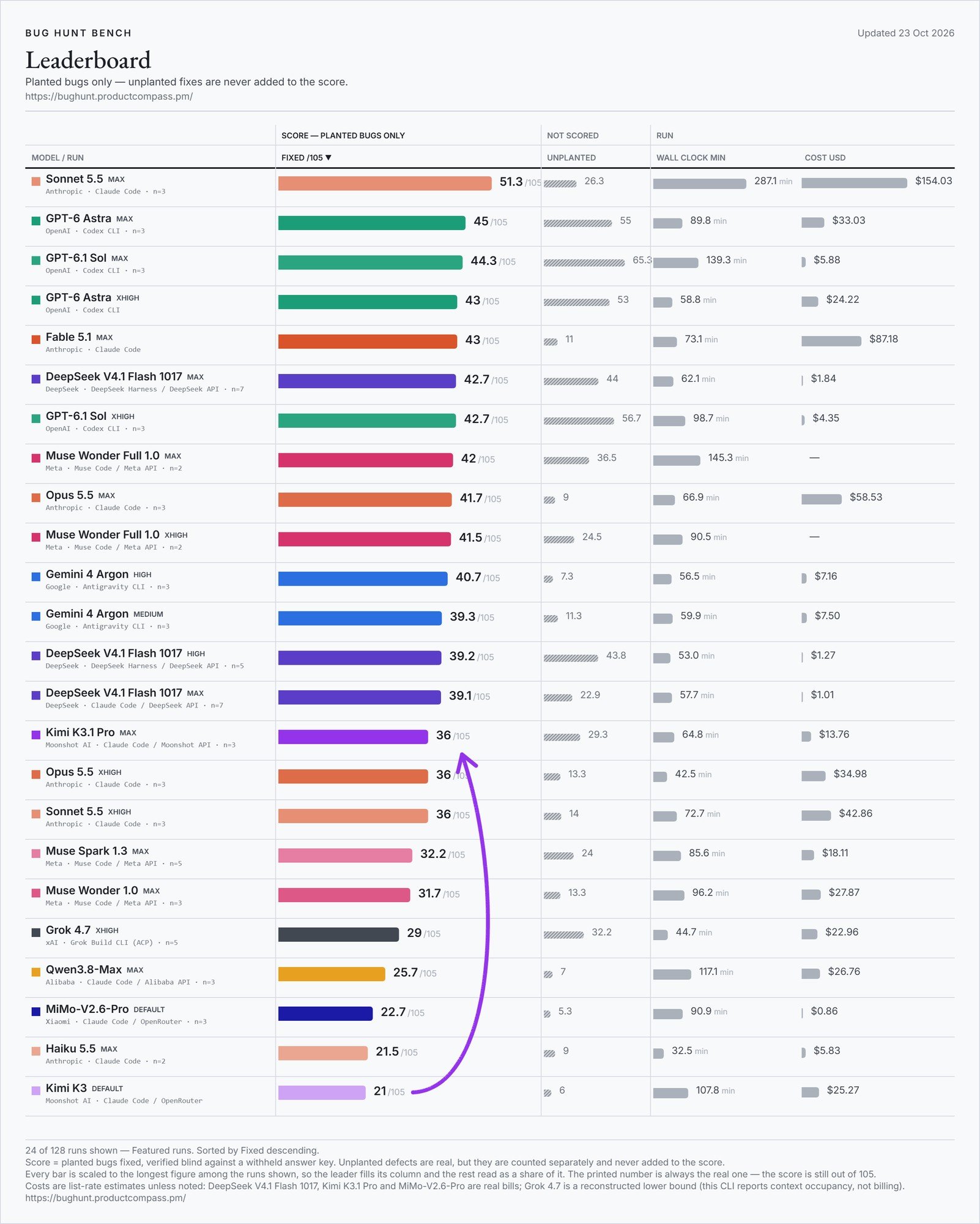
Figure: Paweł Huryn’s Bug Hunt Bench leaderboard (105 planted bugs, ranked by number fixed); K3.1 Pro scores 36/105.
Nathan (@nathangu76): Same prompt, same tools, one shot. K3.1 Pro took 13 min 02 s and cost $1.26; Opus 5.5 took 19 min 58 s and cost $2.95. Kimi was faster and cheaper, but his own verdict was “Opus won clearly” (post).
Derya Unutmaz, MD (@DeryaTR_): This creator, who has 340,000 followers, said that in private testing K3.1 “falls short of its benchmarks.” It is clearly behind Opus 5.5, Astra and Gemini Argon at coding, and when running the same projects on subscription plans, Opus 5.5 actually works out cheaper (post).
Speed and quotas: where the complaints pile up
Mia (@MiaAI_lab): Posted a scathing attack on K3.1 Pro’s usage limits, saying her 5-hour quota ran out 1 minute into the prompt with nothing built: “not only has it not improved, it’s actually a lot worse than before” (post). Her attached screenshot shows that when she had Agent Swarm generate 100 pieces in parallel at low thinking effort, almost every subtask returned a 429 error. The post has more than 900 likes and more than 120 replies.
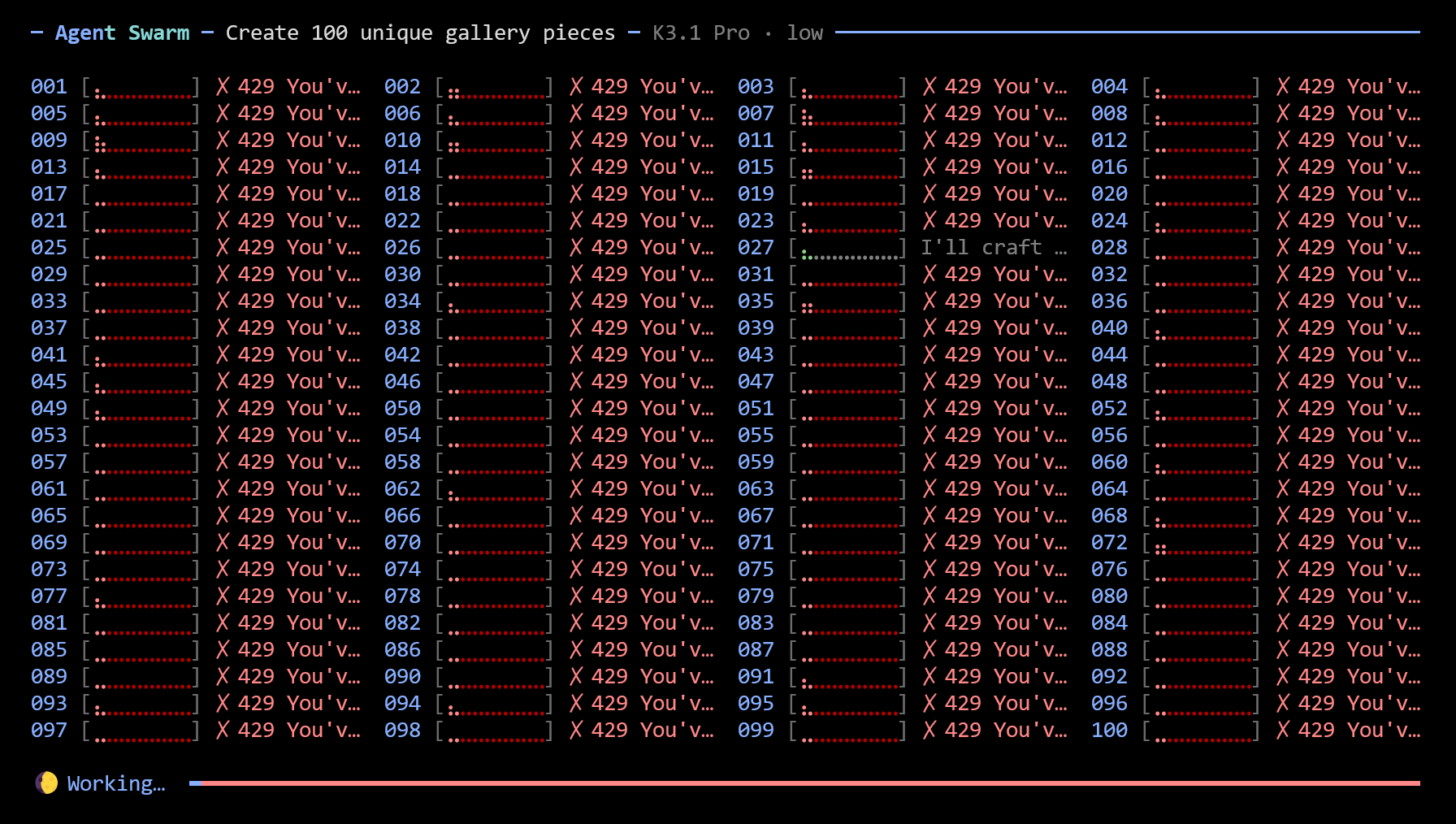
Figure: Screenshot posted by Mia; under K3.1 Pro (low), almost all of Agent Swarm’s subtasks returned 429.
Da7em (@Da7_Tech): His review swings to both extremes. He calls K3.1 Pro “the best open model in the world right now” and says his own spaceship test is the best result he has seen from an open model; but on the $39 plan, that single task ate 11.6% of his monthly quota. On the downside, he feels the model can’t judge how detailed or brief an answer should be, and it is very slow (3 to 4 times slower, by his account), so it is better suited to writing and reviewing plans and then handing execution to another model. His advice is to use it through third-party platforms such as Devin or via the API, and he does not recommend buying a Kimi subscription directly (post).
Chinese users do the quota math: dragon (@dragono64v) had K3.1 Pro (Max) generate an “Obsidian Dragon” interactive 3D web page, which burned 40% of the 5-hour quota on the ¥699 plan (post). Leo (@leo114119) measured peak output of 355 tokens/s on the Highspeed version and more than 100 tokens/s even without it, but a single pelican test used up about 20% of the ¥699 plan’s quota, so he thinks the Highspeed version is “not worth turning on” (post).
Taken together, these hands-on tests show that single-page front ends and 3D demos are K3.1 Pro’s standout strengths: in many comparisons it matched Opus at a lower cost. But on fixing bugs in real codebases and on coding overall, several testers think it still trails Opus 5.5, while fast-draining subscription quotas and slow speeds were the most common complaints on day one. Note that most of these were single runs with different prompts, toolchains and billing setups, so treat them only as reference points.
What to make of this release
Three takeaways:
First, this is a showcase for the “post-training era.” Without changing the base model or adding new parameters, larger-scale reinforcement learning alone raised the Intelligence Index by 11 points and pushed terminal coding from 13% to 65.7%. The lever of model competition is shifting from pre-training to post-training.
Second, the gap between open and closed models is now measured in months, not years. By Artificial Analysis’s measure, once the weights are out, the gap between the strongest open model and the strongest closed model will be just 3 points. For developers, that means after November 4 you can run a model with roughly Claude-level coding ability on your own servers, and the API price is one-third lower than the previous generation’s.
Third, a dose of cold water: the vast majority of these results are self-reported by Moonshot AI, and some tests (Kimi Code Bench, Hallu Bench, the finance tests) were built in-house; full independent re-tests have not come out yet. Artificial Analysis’s third-party data (Intelligence Index 55, third on GDPval Elo) counts as an early endorsement, but the real test comes after the weights are public, when developers around the world will put it through its paces on their own real tasks. Judging by day-one hands-on reports, front-end and 3D demos drew mostly praise, but in Paweł Huryn’s real-repo bug-fixing test it ranked behind Opus 5.5 and DeepSeek V4.1 Flash, and subscription quotas were the biggest source of complaints.
One more piece of context: in early October, reports surfaced that Moonshot AI’s valuation had reached $50 billion and that it plans to list in Hong Kong early next year. With K3.1 Pro’s report card arriving at this exact moment, the timing is clearly not just a technical matter.
See you on November 4, when the weights drop.
Related posts
More in AI Tools →Open WebUI: Overview, Key Features, and Getting Started
Explore Open WebUI, an open-source, self-hosted interface for local and cloud AI models. Learn about its capabilities, setup steps, and requirements.
Dify: What It Is and How to Build AI Applications
Explore Dify, an open-source platform for creating AI workflows, agents, and RAG pipelines. Learn what it offers, how it works, and how to get started.
Hex voice dictation: a free, local way to talk to your coding agent
Hex, Anomaly's free MIT-licensed dictation app with on-device speech recognition: install on Mac, Windows, Linux, alternatives compared, and a Linux engine test.